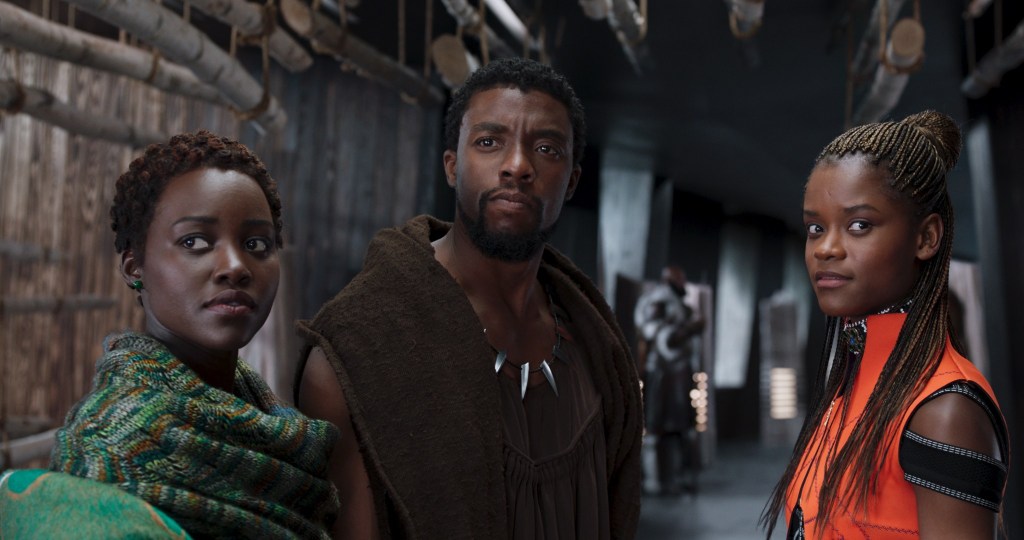
Synopsis: After the death of his father, T’Challa returns home to the African nation of Wakanda to take his rightful place as king. When a powerful enemy suddenly reappears, T’Challa’s mettle as king — and as Black Panther — gets tested when he’s drawn into a conflict that puts the fate of Wakanda and the entire world at risk. Faced with treachery and danger, the young king must rally his allies and release the full power of Black Panther to defeat his foes and secure the safety of his people. (Google)
Cast: Chadwick Boseman, Michael B. Jordan, Lupita Nyong’o, Danai Gurira, Martin Freeman, Daniel Kaluuya, Letitia Wright, Winston Duke, Angela Bassett, Forest Whitaker, Andy Serkis
Screenplay: Ryan Coogler, Joe Robert Cole
Directed by: Ryan Coogler
If we’re talking about history, Ryan Coogler’s BLACK PANTHER is definitely not the first (lead) black superhero to ever grace the silver screen. But it’s safe to say that none of the ones which came before it, was made in the level of nuance and gravitas the way this film was. Coogler broke new grounds (and from what I’m hearing, records too) in terms of racial and gender inclusion/politics into a big franchise without abandoning the essential elements of a superhero movie.
One of the first things I noticed (and deeply felt) from the first few minutes of this movie, other than the incredibly rich world-building of Wakanda was, how it’s so obvious the sense of pride from Coogler for bring Wakanda’s, and to some extent, Black culture, to life. I’m a person of color, but not exactly a minority in the place I’m living, but I even got teary-eyed seeing a culture being represented, not just for mere exotic accessories or a detour of plotlines, but to be truly and deeply celebrated.
Being an action film (and an entry for a Marvel Cinematic Universe), Coogler did not really try something new for the action sequences–except perhaps the inclusion of more female warriors and war rhinos(lol!). Instead, Coogler was opting for a family drama in the vain of a Shakespearean tragedy, and in the process he gave more depth into the characters, most especially the villain, Eric Killmonger.
And a lot has been said about the female of Wakanda. These badass women have their own agenda, motive and real characterizations. From Nakia’s spy activities, Okoye’s loyalty, and Shuri’s millenial princess attitude. Plus, how refreshing it is to see that most of the male characters didn’t fall into the hypermasculinity archetype and didn’t shy away from displaying their emotions (Erik breaking down at the sight of his father, T’Challa’s affection towards his mother and sister, or W’Kabi choosing love over his pride).
Some of you will probably implicate my review for being too political. But how could I not, since some of the conflicts in this film is politically charged? And what’s wrong with that? One of the things films are for is to convey a message; and Coogler did it with such self-assured way, that it’s so smoothly fused into an exciting superhero origin story.
With eclectic crafts (those costumes! the music!), amazing performances from some of the most talented black actors working today, and a great story (and backstory) of power and privilege, BLACK PANTHER is now joining the likes of IRON MAN 3 and DOCTOR STRANGE to be among my favorites from MCU. [A-]
A copy of my review on Instagram.
 Cinema Prescription
Leave a comment